
Hundreds Dead, Thousands Missing as Devastating Floods Sweep South-East Asia

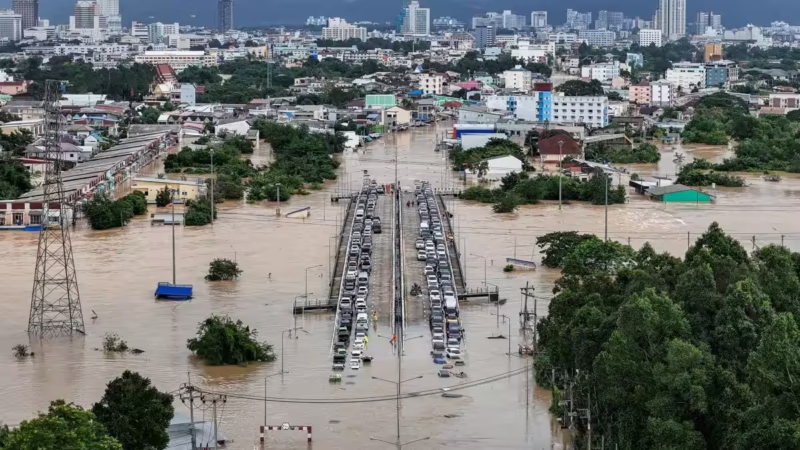
Deadly Floods in South Asia
Devastating Floods Sweep South and South-East Asia: One of the worst bouts of extreme weather in decades has battered South and South-East Asia, leaving hundreds dead, thousands missing, and millions affected. Exceptionally heavy monsoon rains—amplified by tropical storms and two rare cyclonic systems—have triggered catastrophic flooding, landslides, and widespread destruction across Indonesia, Thailand, Malaysia, and Sri Lanka, while Vietnam braces for further impacts.
- Unusually heavy rains across parts of South and South-East Asia have caused widespread devastation.
- Sumatra, Indonesia, reports at least 90 deaths, with dozens still missing as rescue teams search through damaged and flooded areas.
- The region as a whole is experiencing some of the worst flooding in years, affecting millions across Indonesia, Vietnam, Thailand, and Malaysia.
- In Thailand, deadly floods have pushed the death toll to 145, forcing authorities to move 11 South East Asian Games events to Bangkok because southern provinces are too badly affected.
- Sri Lanka has been struck by record floods and landslides, killing 100+ people, worsened by the arrival of Cyclone Ditwah which brought additional heavy rains.
- Ongoing rescue efforts across several countries are being slowed by power cuts, mudslides, blocked roads, and continued severe weather, leaving many communities isolated and difficult to reach.
Indonesia
Indonesia has been hit the hardest, particularly the island of Sumatra, where the death toll has surpassed 300. Authorities warn that the number may climb as dozens remain unaccounted for and entire communities remain cut off.
Key Impacts
- Cyclone Senyar, an unusually rare storm forming in the Malacca Strait, unleashed torrential rainfall across several provinces.
- Fast-moving waters caused sudden flash floods in Aceh and West Sumatra, sweeping away homes and submerging thousands of structures.
- Communications remain only partially restored, with significant outages in internet and electricity.
- Evacuation routes have been severed by damaged bridges and impassable roads.
- In Tapanuli—one of the worst-affected regions—food shortages led desperate residents to ransack shops for supplies.
Human Stories
Residents described water levels rising in seconds.
One survivor, Arini Amalia of Aceh Province, said the flood swallowed her house entirely within a day. Another, Meri Osman, was swept away by the current and survived only by clinging to a clothesline.
With rescue operations slow due to the weather, pressure is mounting on Jakarta to declare a national disaster, which would unlock resources for a far-greater coordinated response.
Thailand
Thailand has recorded at least 170 deaths, primarily in the southern provinces, following one of the most destructive floods in a decade.
Key Impacts
- Floodwaters in Songkhla province rose up to 3 meters (10 ft).
- Across 10 affected provinces, more than 3.8 million people are impacted.
- The city of Hat Yai experienced a staggering 335 mm of rainfall in a single day—the heaviest in 300 years.
- As waters receded, authorities reported a sharp rise in casualties.
Humanitarian Situation
- Hospitals in Hat Yai were so overwhelmed that bodies had to be stored in refrigerated trucks.
- Tens of thousands are sheltering in temporary facilities.
- Residents say aid has been slow. One, Thanita Khiawhom, reported being stranded in rising water for seven days without assistance.
The Thai government has promised financial support, including compensation of up to two million baht (~$62,000) for families who lost loved ones.
Malaysia
Malaysia has experienced a lower death toll—two reported deaths—but the humanitarian and structural damage is severe, especially in the northern state of Perlis.
Key Impacts
- Entire communities in Perlis remain underwater.
- tens of thousands have been forced into emergency shelters.
- Infrastructure damage is extensive, with submerged homes, destroyed roads, and widespread power outages.
While Malaysia avoided the catastrophic death toll seen in Indonesia and Thailand, the scale of property damage and displacement has been immense.
Sri Lanka
Sri Lanka has been devastated by Cyclone Ditwah, which triggered some of the worst flooding and landslides the country has seen in recent years.
Key Impacts
- At least 193 people have died, with more than 200 still missing.
- Over 15,000 homes destroyed and 78,000 people displaced into temporary shelters.
- Roughly one-third of the country is without electricity or running water.
- A state of emergency has been declared for faster response and relief distribution.
The severity of the damage highlights Sri Lanka’s growing vulnerability to extreme weather intensified by climatic shifts.
Vietnam
Vietnam is bracing itself as Typhoon Koto, which already swept across the Philippines, approaches the Vietnamese coastline.
Current Impacts
- At least three people have been killed and one missing, according to early reports.
- Coastal provinces are preparing for further flooding and landslides as the storm approaches.
Authorities fear that the interaction between Typhoon Koto and regional monsoon systems may worsen conditions.
Why This Event Was So Extreme
Meteorologists point to a rare combination of factors:
- Interaction between Typhoon Koto and Cyclone Senyar, which amplified moisture and storm intensity.
- Unusually strong monsoon systems across South and South-East Asia.
- Long-term climate trends that are making storms more frequent, more intense, and wetter.
While scientists caution against attributing any single storm directly to climate change, the pattern of stronger rainfall events and destructive flooding is becoming increasingly clear.
Cyclones and Typhoon
Cyclone Senyar
Cyclone Senyar was an exceptionally rare tropical cyclone that formed in the Malacca Strait, a very narrow body of water between Indonesia and Malaysia where cyclones almost never develop.
Because of the unusual location and warm sea temperatures, Senyar intensified rapidly and brought extreme rainfall to Sumatra (Indonesia), triggering:
- Flash floods
- Massive landslides
- Widespread destruction of homes and roads
Senyar’s formation was one of the key reasons Indonesia suffered the highest death toll.
Cyclone Ditwah
Cyclone Ditwah hit Sri Lanka, bringing intense rainfall and strong winds that caused:
- Deadly flooding
- Mudslides
- Destruction of thousands of homes
- Power and water outages across nearly one-third of the country
Ditwah’s slow movement over the island allowed it to drop enormous amounts of rain, making it one of Sri Lanka’s worst weather disasters in recent years.
Typhoon Koto
Typhoon Koto developed in the western Pacific and crossed the Philippines before heading toward Vietnam.
As it moved west, it:
- Pulled moist air into surrounding weather systems
- Intensified monsoon rains across South-East Asia
- Contributed indirectly to the extreme flooding in Thailand, Malaysia, and Indonesia
While Koto did not directly hit all the affected countries, its interaction with regional weather patterns amplified rainfall and storm intensity across the region.



Comments are closed.