
Fort Cornwallis

Synopsis
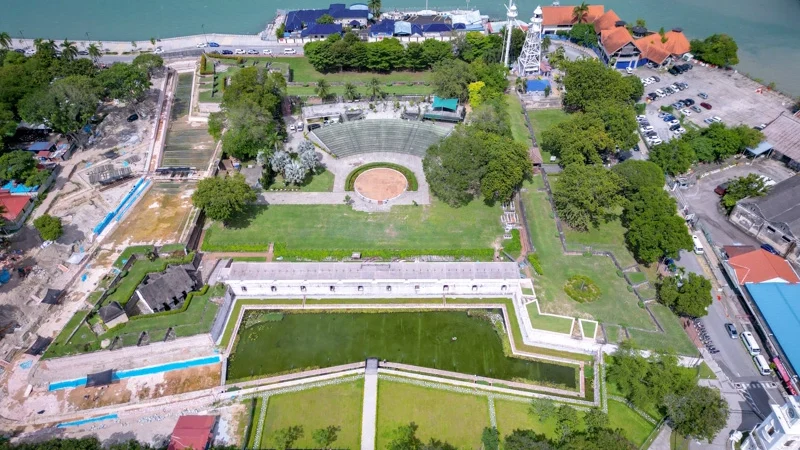
Fort Cornwallis in Penang stands as Malaysia’s largest and most intact historical fort. Built in 1786, this star-shaped fortress reflects the colonial beginnings of George Town under British rule and remains a key symbol of the island’s maritime and military past.
Overview
Located along the Esplanade in George Town, Penang, Fort Cornwallis was originally constructed by Captain Francis Light to protect the newly established British settlement from potential attacks. Named after Charles Marquis Cornwallis, the Governor-General of Bengal, the fort was initially made of nibong palms before being rebuilt with bricks and stone in the early 19th century. Today, it serves as both a historical landmark and cultural attraction, offering visitors a glimpse into Penang’s colonial heritage.
Fort Quick Facts
- Location: The Esplanade, George Town, Penang, Malaysia
- Year Built: 1786
- Type: Coastal Fortress
- Built By: Captain Francis Light, British East India Company
- Architectural Style: Star-shaped bastion fort
- Significance: Oldest and largest surviving fort in Malaysia
History
Fort Cornwallis began as a wooden defensive stockade built shortly after Francis Light took possession of Penang Island on behalf of the British East India Company. By 1804, to better defend against naval threats, it was reconstructed using bricks and reinforced with cannons salvaged from other colonial ships.
Throughout its history, the fort never faced any actual combat; instead, it served administrative and ceremonial functions. During the Japanese occupation (1941–1945), it was used as a base by Japanese forces. Today, it stands as a museum and open-air historical park, preserving the story of Penang’s colonial origins.
Architectural Highlights
Fort Cornwallis is designed in a star-shaped layout typical of 18th-century European military architecture. The bastions are equipped with British-era cannons, including the famous Sri Rambai Cannon, a Dutch-made weapon believed to bring fertility blessings to women.
Visitors can explore the gunpowder magazine, chapel ruins, old cells, lighthouse, and bronze statues of Francis Light—all surrounded by scenic coastal views of the Penang waterfront.
Legends & Mysteries
The Sri Rambai Cannon carries a popular local legend. It is said that women who place flowers or offerings near the cannon will be blessed with fertility. This blend of colonial artifact and local folklore adds a unique cultural charm to the fort.
Visiting Information
- Opening Hours: 9:00 AM – 6:30 PM daily
- Entry Fee: Around RM 10 (Adults), RM 5 (Children)
- Facilities: Guided tours, souvenir shop, rest areas, and museum displays
- Best Time to Visit: Morning or late afternoon for cooler temperatures and soft lighting for photography
Things to Do
- Walk along the battlements and enjoy panoramic views of George Town’s waterfront.
- Visit the Sri Rambai Cannon and learn about its folklore.
- Explore historical exhibits detailing the British East India Company’s influence in Penang.
- Capture photos of the Francis Light bronze statue and colonial structures.
- Attend cultural and historical exhibitions occasionally hosted within the fort.
Nearby Attractions
- Esplanade (Padang Kota Lama): A popular seafront promenade.
- Penang State Museum: Insight into Penang’s multicultural heritage.
- Cheong Fatt Tze Mansion: A famous blue mansion showcasing Straits architecture.
- Pinang Peranakan Mansion: A heritage house reflecting Peranakan culture.
- Clan Jetties of George Town: Wooden stilt villages preserving Chinese settler history.
How to Reach Fort Cornwallis
- By Car: About 10 minutes from George Town’s city center; parking available nearby.
- By Bus: Take Rapid Penang Bus 101, 103, or 104 to the Esplanade stop.
- By Ferry: A short walk from the Penang Ferry Terminal.
- By Bicycle/Walk: Easily accessible via the George Town Heritage Trail.
Frequently Asked Questions (FAQ)
Q1: Why is Fort Cornwallis important?
It symbolizes the beginning of British rule in Penang and is Malaysia’s oldest surviving fort, representing the colonial era’s architecture and defense systems.
Q2: Can visitors enter all areas of the fort?
Yes, most sections are open to the public, including the cannon bastions, lighthouse, and inner courtyards.
Q3: Is Fort Cornwallis suitable for families?
Absolutely. It’s an educational and family-friendly attraction with ample open space and historical exhibits.
Q4: Is there a guided tour available?
Yes, guided tours are offered for deeper insights into the fort’s history and legends.




Comments are closed.