
Kuala Lumpur: Another Sinkhole at Jalan Masjid India Where Tourist Went Missing

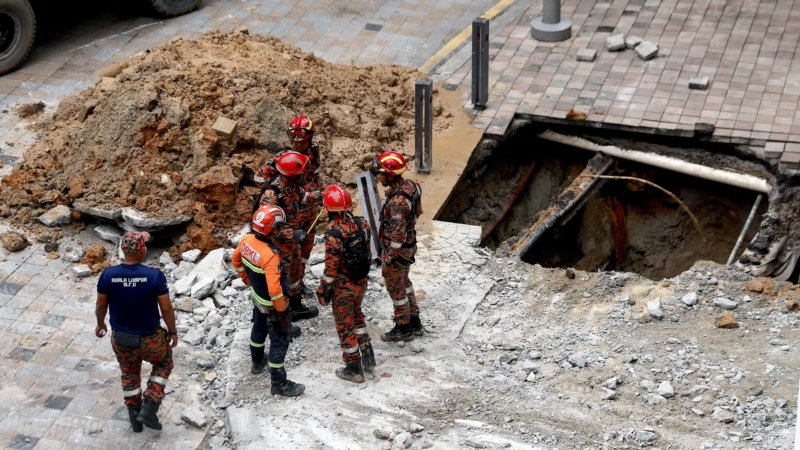
KUALA LUMPUR, Nov 10 — A fresh ground collapse has been reported along Jalan Masjid India, one of Kuala Lumpur’s busiest commercial streets, near the site where an Indian tourist went missing following a sinkhole incident in August 2024.
According to Kuala Lumpur City Hall (DBKL), the latest occurrence — initially described as a “sinkhole” — appeared around 8.40 am on Sunday, near the Bombay Jewellery outlet along Jalan Bunus, adjacent to Jalan Masjid India.
| Aspect | Details |
|---|---|
| Location | Jalan Masjid India / Jalan Bunus, Kuala Lumpur |
| Latest Incident Date | November 10, 2025 |
| Classification | Ground settlement (not sinkhole) |
| Cause (2024 Incident) | Corroded sewer pipe and soil instability |
| Actions Taken | Road closures, technical surveys, infrastructure review |
| Status | Area under monitoring by DBKL |
Ground Settlement, Not Sinkhole
In a press statement, Kuala Lumpur Mayor Datuk Kamarulzaman Mat Salleh clarified that the cavity was not a sinkhole but a ground settlement caused by underground soil movement.
“Initial assessments indicate this is surface subsidence, not a full collapse. There is no need for public panic,” the mayor said.
City engineers have cordoned off the area and begun detailed inspections. Vehicular access along parts of Jalan Masjid India has been temporarily closed, with traffic diverted to adjacent lanes.
Linked to 2024 Incident
The location is just metres away from the site where a 48-year-old Indian tourist fell into an eight-metre-deep sinkhole on Aug 23, 2024. Despite extensive rescue efforts, the tourist was never recovered, and the tragedy drew national attention to Kuala Lumpur’s ageing underground infrastructure.
A federal task force later determined that the 2024 collapse was triggered by a corroded sewer pipe, not natural limestone erosion, ruling out geological faulting as the primary cause.
Investigation Underway
DBKL has commissioned a new round of geotechnical and structural assessments using ground-penetrating radar (GPR), borehole testing, LiDAR mapping, and satellite-based InSAR analysis to evaluate soil stability in the vicinity.
Officials said a long-term remedial plan involving sewer replacement, soil stabilisation, and improved storm-drainage systems is being implemented as part of a broader infrastructure resilience initiative across downtown Kuala Lumpur.
Public Safety Measures
Authorities have urged the public to avoid restricted areas while monitoring continues. Businesses nearby remain open, though several shopowners report lighter foot traffic since news of the incident broke.
“People are still worried, but DBKL officers have been very quick to act,” said a textile-store owner along Jalan Masjid India. “They’ve covered the area and explained that it’s not dangerous, so we hope business returns to normal soon.”
Tourism and Infrastructure Concerns
Jalan Masjid India, known for its heritage shophouses, Indian-Muslim eateries, and textile markets, is a major draw for both tourists and locals. The recurring ground issues have, however, raised concerns about urban infrastructure maintenance in one of the capital’s oldest commercial corridors.
Urban-planning analysts note that Kuala Lumpur’s combination of dense underground utility networks and heavy surface activity makes it particularly vulnerable to subsidence if ageing systems are not consistently upgraded.
Looking Ahead
While authorities have assured that there is no immediate structural danger, engineers are conducting round-the-clock monitoring until all assessments are complete.
The public inquiry report into the 2024 sinkhole incident — and subsequent preventive actions — is expected to be tabled by the end of 2025.




Comments are closed.